

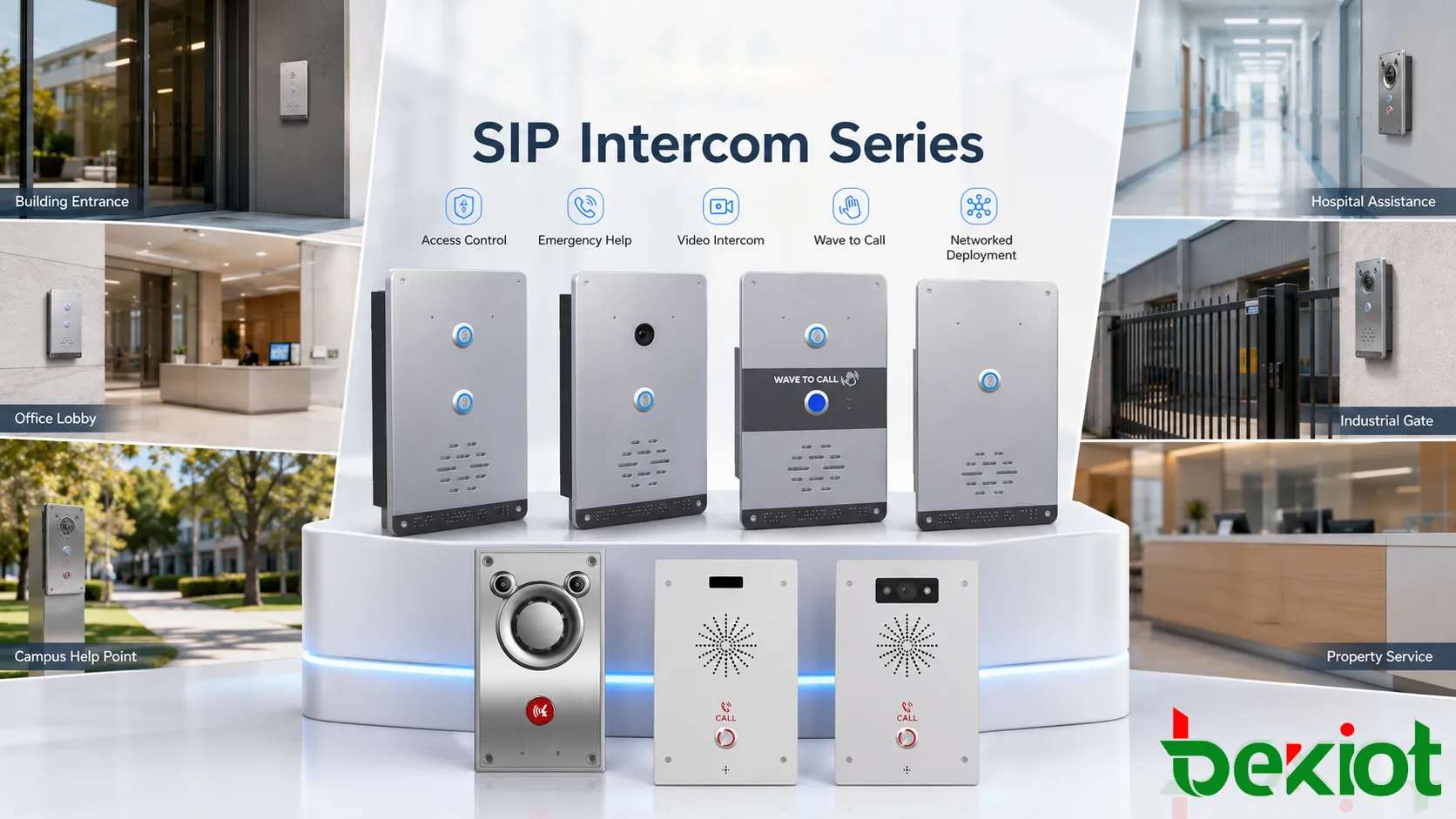
Modern security communication is moving away from isolated analog intercoms and toward IP-based endpoints that can work with VoIP systems, access control platforms, video monitoring, IoT messaging, and centralized management. The EI Series network security intercoms are designed around this transition. Instead of serving only as simple call buttons, they act as SIP terminals that support full-duplex voice, secure access control, network management, and optional video communication for indoor and outdoor security points.
The series includes four models: Ei-D05, Ei-V05, Ei-W05, and Ei-A05. These models are intended for different installation and application requirements while maintaining the same engineering direction: reliable VoIP communication, compact metal construction, flexible mounting, and integration with security communication systems in commercial buildings, schools, universities, healthcare facilities, warehouses, retail sites, and similar environments.
Why IP-Based Security Intercoms Are Replacing Standalone Door Communication Devices
Traditional intercom systems usually depend on point-to-point wiring, proprietary control units, or local analog audio paths. That structure can be sufficient for small installations, but it becomes difficult to scale when a facility needs centralized calling, remote answering, event logging, visitor access control, video confirmation, or connection with a SIP-based communication platform.
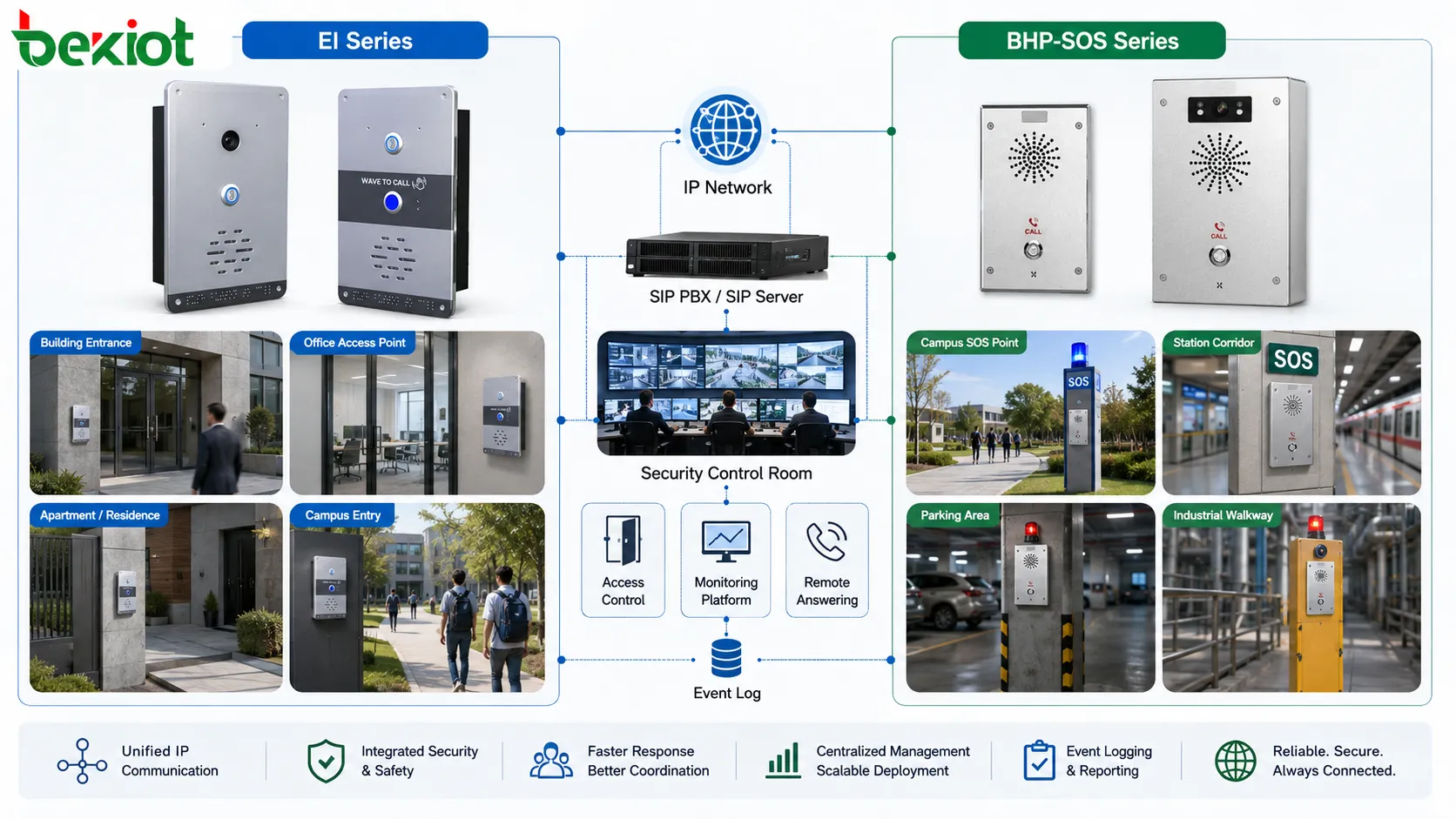
The EI Series follows a networked model. Each terminal can connect to an IP network and communicate through SIP, allowing it to become part of a broader VoIP system. For engineering teams, this means the intercom endpoint can be planned together with IP PBX systems, SIP servers, security control rooms, monitoring platforms, and network infrastructure rather than being treated as an isolated low-voltage subsystem.
Model Portfolio and Practical Selection Logic
The EI Series provides four model options: Ei-D05, Ei-V05, Ei-W05, and Ei-A05. The most important engineering distinction is that the Ei-V05 supports video, while the Ei-A05, Ei-D05, and Ei-W05 are positioned as non-video intercom terminals. This separation gives integrators a practical way to choose between audio-only access communication and audio-video verification.
For building entrances, reception doors, visitor access points, and locations where visual confirmation is required, the Ei-V05 is the more suitable option because it supports a camera and H.264 video encoding. For internal help points, warehouse communication, service counters, restricted-area doors, or locations where voice communication is enough, the audio-focused models can reduce cost and simplify deployment.
Ei-V05 for video-enabled access communication
The Ei-V05 supports video capture at 1280×720 at 20fps and 640×360 at 20fps. This resolution and frame rate are practical for access control and security verification, where the goal is to identify visitors, confirm activity near a door, and provide operators with enough visual context for a response.
Its video stream uses H.264 encoding, a widely supported compression format in video monitoring and network communication systems. This makes the model easier to integrate into environments where video streams need to be viewed, recorded, or transmitted across standard IP networks.
Ei-A05, Ei-D05, and Ei-W05 for voice-first deployments
The Ei-A05, Ei-D05, and Ei-W05 are better suited to scenarios where the primary requirement is stable two-way voice rather than video. In many industrial, commercial, and public facility projects, the most important requirement is not high-resolution imaging but fast, clear, and reliable communication between the field point and the control center.
Voice-first terminals are also useful where privacy, bandwidth, or budget constraints make video unnecessary. They can still participate in SIP-based call routing, central management, and networked intercom operation without adding the complexity of camera integration.
Audio Architecture: Clear Voice Is the Core of Security Communication
Security intercoms are often installed in noisy or semi-open environments, so audio performance is not a secondary detail. The EI Series uses a Φ40 full-range speaker driver with 96±3dB sensitivity at 1M/1W. This provides a practical sound output foundation for door communication, help points, and facility service calls.
The terminal uses a 5W Class D power amplifier and an 8Ω 5W rated speaker output. The listed distortion rate is below 1%, and the frequency response range is 100Hz to 20KHz. For intercom use, this range supports speech clarity while still allowing the terminal to handle notification audio or streamed MP3 content when needed.
The microphone sensitivity is -36±2dB, which is suitable for close-range voice pickup at entrances, wall-mounted help points, and operator-facing communication points. The audio output is mono, which is appropriate for intercom scenarios where speech intelligibility and reliability matter more than stereo imaging.
Codec and Media Support for SIP Communication
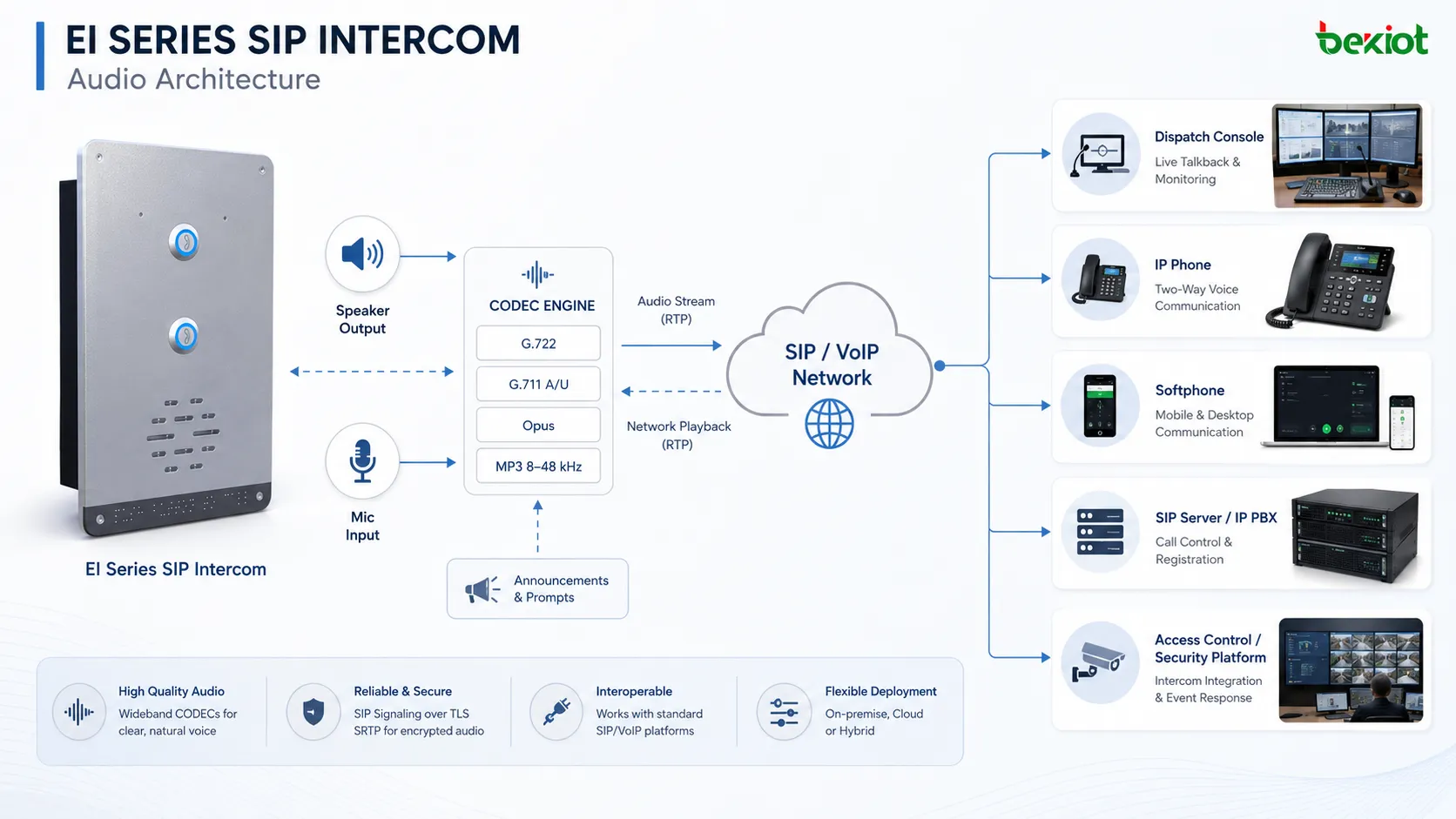
The EI Series supports G.722, G.711 A-law, G.711 U-law, and Opus audio codecs. This codec combination is important because it balances compatibility and voice quality. G.711 remains widely used in traditional VoIP environments because of its broad interoperability, while G.722 can provide wideband voice for clearer speech when the SIP system supports it.
Opus support is especially valuable for modern IP communication because it can adapt well to different network conditions and bandwidth requirements. In real deployments, codec selection often depends on SIP server configuration, WAN quality, local network stability, and whether the terminal is communicating with an IP phone, dispatch console, softphone, or access control platform.
The terminal also supports MP3 audio streams with sampling rates from 8KHz to 48KHz and bitrates from 64kbps to 320kbps, in mono or stereo. This expands the device beyond basic call audio and allows it to support network audio playback scenarios such as announcements, prompts, or local notification tones.
Protocol Stack and Integration Value
The EI Series supports SIP based on RFC3261, which is the foundation for registration, call setup, and session control in many VoIP systems. This allows the intercom terminal to work as a SIP endpoint instead of being limited to a proprietary communication path.
Beyond SIP, the protocol set includes HTTP, TCP/IP, SSL, DNS, SNTP, NTP, RTSP, RTP, RTCP, TCP, UDP, MQTT, ICMP, DHCP, ARP, and SSH. This mix matters because a modern intercom terminal needs more than call signaling. It needs media transport, time synchronization, network discovery, secure access, remote administration, stream handling, and event communication.
SIP, RTP, and RTCP for voice sessions
SIP handles call signaling, while RTP carries real-time audio media. RTCP provides control and quality feedback for media sessions. In engineering terms, this separation makes the terminal compatible with many VoIP architectures, including IP PBX platforms, SIP servers, and dispatch communication systems.
For sites with multiple entrances, service points, or emergency assistance stations, SIP registration makes the intercom easier to manage. Each device can be assigned an extension, call destination, group rule, or routing policy, allowing security staff to answer calls from fixed phones, softphones, control-room consoles, or integrated communication platforms.
RTSP and H.264 for video-capable deployment
For the Ei-V05, RTSP and H.264 support are essential because they make the video stream more usable in IP-based security environments. RTSP is commonly used for stream control, while H.264 keeps video bandwidth more manageable than uncompressed transmission.
This is useful when the intercom needs to work with monitoring software or when operators need visual confirmation before granting access. The video function should be evaluated together with network bandwidth, storage strategy, stream viewing requirements, and the security platform used by the project.
MQTT for IoT-oriented event communication
MQTT support gives the EI Series additional value in IoT-style deployments. Instead of treating intercom events only as calls, an integrated platform can use MQTT messaging for event-driven workflows, device status updates, or linkage with other systems.
For example, a button press, call state, access event, or device status change can become part of a broader automation flow. This is especially useful in smart buildings, campuses, industrial facilities, and unattended service areas where communication events need to trigger security, operation, or maintenance actions.
Management, Provisioning, and Maintenance
The EI Series can be configured through a web management interface or an automatic configuration server. This is important for projects with many terminals because manual device-by-device configuration increases labor cost and introduces inconsistency.
Automatic provisioning allows standard parameters such as SIP account settings, server addresses, call destinations, network configuration, and functional options to be delivered more efficiently. For integrators, this improves deployment speed and makes future maintenance easier when devices need to be replaced, updated, or reconfigured.
SSH support is also useful for technical maintenance, especially when advanced troubleshooting or controlled remote access is required. In security-sensitive environments, SSH access should be managed carefully with strong credentials, restricted access policies, and network segmentation.
Power, Network Interface, and Field Wiring Considerations
All models use a 10/100Mbps network interface and support PoE. The Ei-V05 supports PoE IEEE 802.3at, while the Ei-A05, Ei-D05, and Ei-W05 support PoE IEEE 802.3af/at. This difference is practical because the video-enabled model has higher power requirements than the audio-only models.
The Ei-V05 can also use a 12V-2A DC power input. The Ei-A05, Ei-D05, and Ei-W05 can use a 12V-1A DC power input. This dual power approach gives installers flexibility: PoE simplifies cabling in new network-based projects, while DC power can be useful when existing power infrastructure is already available or when PoE switch capacity is limited.
In project planning, engineers should calculate PoE switch budget, cable distance, VLAN design, backup power, and surge protection. For emergency communication or access control applications, the switch and network path should also be connected to UPS or backup power where continuous operation is required.
Mechanical Design and Installation Flexibility
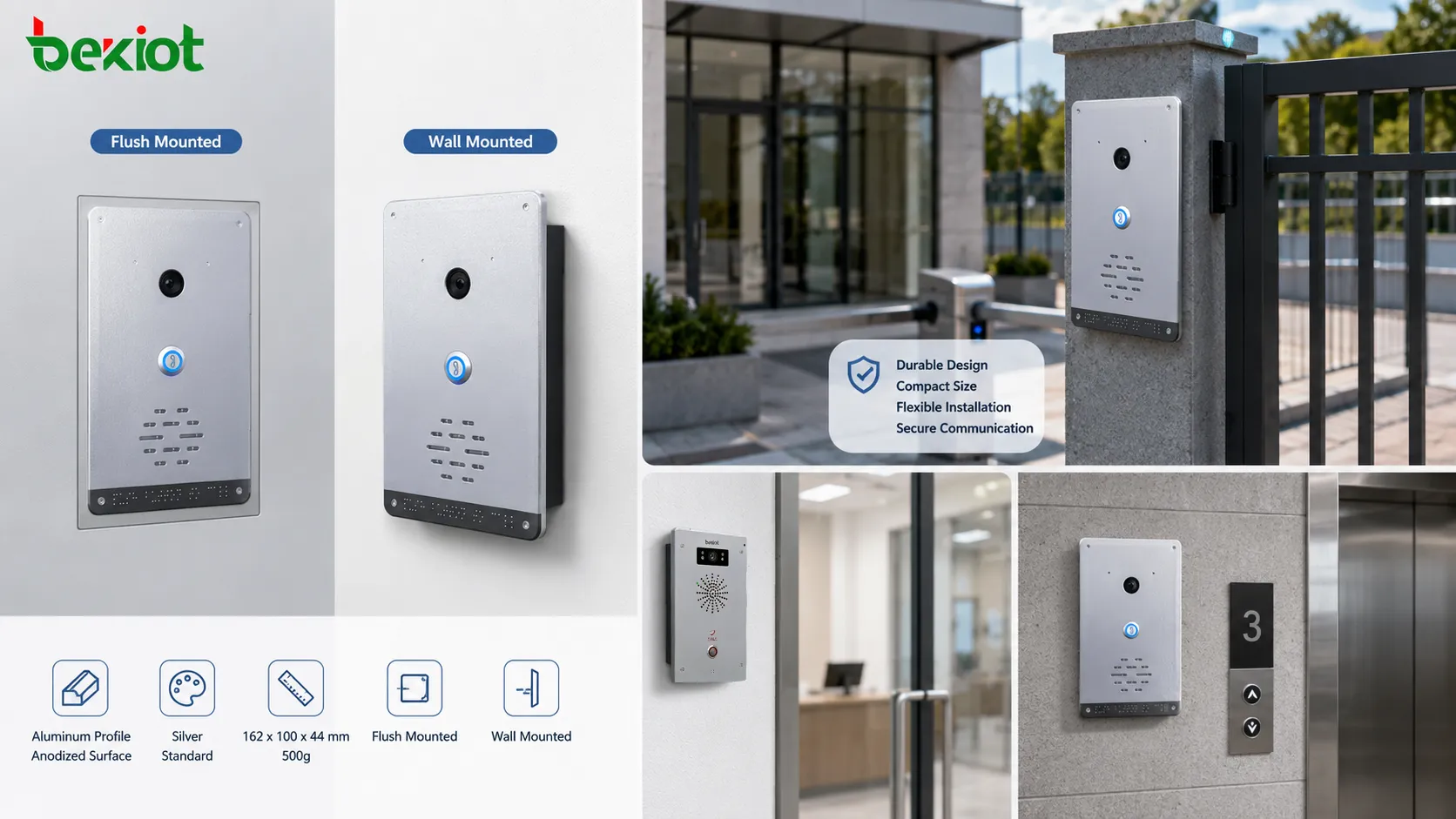
The terminals use an aluminum profile body with anodized surface treatment. This gives the unit a more robust mechanical structure than lightweight plastic terminals and makes it better suited for public-facing or semi-industrial installation points. The standard color is silver.
The device size is 162×100×44mm, and the listed weight is 500g. This compact form factor helps it fit into entrances, corridors, walls, service counters, access points, and help stations without occupying excessive space.
The series supports flush mounting and wall-mounted fixed installation. Flush mounting is suitable for cleaner architectural integration and reduced protrusion from the wall. Wall mounting is more convenient for retrofit projects, fast installation, or locations where wall cutting is not desirable.
Environmental Suitability for Indoor and Outdoor Points
The EI Series is designed for both indoor and outdoor installation environments. The operating temperature range is -20°C to 50°C, or -4°F to 122°F. The storage temperature range is -40°C to 70°C, or -40°F to 158°F. These figures make the series suitable for many commercial and facility environments, although extreme industrial or hazardous areas may still require specialized terminals with higher protection ratings or explosion-proof certification.
The humidity range is 10% to 95% RH without condensation. This is a relevant specification for entrances, parking areas, public corridors, warehouses, and semi-outdoor spaces where humidity can vary significantly. In real projects, condensation, direct rain exposure, dust level, sunlight, vandalism risk, and mounting position should still be evaluated before final installation.
Security and Compliance Considerations
The EI Series includes compliance references such as EN IEC 62368-1:2020+A11:2020, EN 55032:2015/A11:2020, EN 55035:2017/A11:2020, EN IEC 61000-3-2:2019, EN 61000-3-3:2013/A1:2019, and FCC Part 15B. These standards are relevant to electrical safety, electromagnetic compatibility, and radio-frequency emission limits.
For procurement teams, certification information is not just a formality. It affects project acceptance, regional compliance, electrical safety review, and the ability to deploy communication endpoints in regulated facilities. When the terminal is used in public buildings, healthcare facilities, schools, or commercial projects, compliance documents should be checked together with local installation requirements.
Network security also needs attention. Because the terminal supports IP communication, web management, SSH, SIP signaling, and optional video streaming, deployment should include secure passwords, restricted management access, VLAN separation, firewall rules, time synchronization, and regular configuration backup.
Application Scenarios and System Role
The EI Series is suitable for commercial facilities, schools, universities, healthcare facilities, warehouses, retail locations, and similar spaces where fast voice communication and controlled access are needed. Its value is strongest when the intercom point must connect field users with a security desk, reception desk, service team, or operations center.
Commercial buildings and office facilities
In office buildings, intercom terminals can be installed at entrances, restricted doors, service access points, delivery areas, and reception zones. A SIP-based terminal allows calls to be routed to reception phones, security consoles, mobile softphones, or a centralized communication platform.
For multi-tenant buildings, the networked approach also simplifies future expansion. New access points can be added as SIP endpoints without rebuilding the entire intercom system architecture.
Education campuses
Schools and universities need communication points at entrances, dormitories, gates, libraries, parking areas, and administrative buildings. The EI Series can support voice access communication, emergency assistance, visitor confirmation, and communication with campus security teams.
When integrated with a SIP platform, calls from different locations can be identified, routed, recorded, or escalated according to campus operation rules. This helps improve response speed when staff need to locate and handle incidents.
Healthcare and senior care facilities
Healthcare environments require clear communication between controlled entrances, nursing areas, service doors, and security stations. Audio clarity, stable network operation, and centralized response are more important than decorative features.
In senior care facilities, intercom endpoints can support safer access control and staff communication. Where video confirmation is needed, the Ei-V05 provides an additional visual layer for identifying visitors or checking the surrounding area before action is taken.
Warehouses, retail sites, and service points
Warehouses and retail facilities often have receiving doors, staff-only entrances, loading areas, parking zones, and after-hours service points. A SIP intercom terminal gives staff a controlled way to communicate with a central desk without relying on personal mobile phones or unmanaged communication channels.
For large sites, multiple terminals can be registered and managed through the same communication system. This helps unify call handling, maintenance, and access communication across different areas.
Engineering Value in a Complete Communication Architecture
The strongest value of the EI Series is not only the device itself, but the role it plays in a larger system. A network security intercom can become part of access control, visitor communication, IP telephony, monitoring, IoT event linkage, and centralized facility management.
For system designers, the key is to avoid treating the intercom as a standalone accessory. It should be planned together with SIP routing, network topology, PoE budget, management permissions, video stream handling, and emergency response procedures. When these elements are aligned, the terminal becomes a reliable field communication node rather than a simple door device.
Selection Checklist for Project Teams
Before choosing an EI Series model, project teams should clarify whether the installation point needs audio-only communication or video verification. If visual confirmation is required, the Ei-V05 is the logical choice. If the requirement is mainly voice calling, the Ei-A05, Ei-D05, or Ei-W05 may be more efficient.
The second decision is installation method. Flush mounting is better for clean building design and reduced physical exposure. Wall mounting is better for retrofit projects, equipment rooms, warehouses, or service areas where fast installation matters.
The third decision is system integration. Engineers should confirm SIP server compatibility, codec requirements, IP addressing strategy, PoE standard, management access, MQTT workflow requirements, and whether RTSP video streaming will be used. These checks reduce integration risk and help the device perform as expected after installation.
Technical Summary
The EI Series represents a practical direction for modern security intercom design: SIP-based communication, full-duplex VoIP calling, optional video, standard network protocols, web or automatic configuration, PoE power, compact aluminum construction, and flexible installation. The combination of G.722, G.711, Opus, MP3 streaming, SIP, RTP, RTCP, RTSP, MQTT, SSH, and HTTP makes the series suitable for more than basic door answering.
For commercial buildings, campuses, healthcare facilities, warehouses, retail environments, and public service points, the EI Series can function as an integrated communication endpoint within a broader IP security architecture. The key to successful deployment is not only selecting the right model, but also designing the network, power, management, and call routing strategy around the real operating environment.
FAQ
Can an EI Series intercom work without a full IP PBX system?
In some small deployments, a SIP intercom may work with direct SIP calling or a lightweight SIP server, but a full IP PBX or SIP platform is usually better for extension management, call routing, recording, permissions, and future expansion.
Is PoE always the best power option for SIP intercom terminals?
PoE is usually preferred because it reduces separate power wiring and supports centralized backup through a PoE switch. However, DC power may be useful in retrofit projects or where PoE switch capacity is limited.
What should be checked before using video from an intercom terminal?
Project teams should check bandwidth, viewing software compatibility, video storage requirements, access permissions, lighting conditions, camera angle, and privacy rules before enabling video-based intercom functions.