

SIP INFO DTMF es un método utilizado en telefonía IP para enviar dígitos del teclado durante una llamada activa a través de mensajes de señalización SIP en lugar de depender del flujo de audio de voz ordinario. En términos prácticos, cuando un usuario presiona una tecla como 0–9, * o # en un teléfono IP, softphone, teléfono analógico conectado a una ATA o un endpoint basado en puerta de enlace, el sistema puede transmitir ese dígito al extremo remoto utilizando una solicitud SIP INFO en lugar de incrustar el tono solo dentro de la ruta de audio. Esto es importante porque el DTMF sigue siendo esencial en los sistemas de comunicación modernos para la navegación por IVR, acceso al correo de voz, control de puentes de conferencia, ingreso de NIP, selección de colas, menús de autoservicio y muchos tipos de interacción automatizada.
En implementaciones reales, SIP INFO DTMF a menudo se analiza junto con otros métodos de transporte de DTMF, como el DTMF en banda y los eventos telefónicos RTP RFC 2833, que en el lenguaje actual de estándares están más estrechamente asociados con RFC 4733. Todos estos métodos apuntan al mismo objetivo operativo, que es transportar los dígitos ingresados por el usuario de un lado de la llamada al otro. Sin embargo, lo hacen de diferentes maneras y con diferentes implicaciones para el comportamiento del códec, la interfuncionamiento, la señalización de llamadas, el manejo de medios, la compatibilidad con proveedores de servicios y el diseño de la plataforma.
SIP INFO DTMF sigue siendo importante porque brinda a los sistemas VoIP otra forma de transportar información de dígitos que no depende de la preservación del tono de audio. Es especialmente relevante en entornos mixtos donde los endpoints, puertas de enlace, centralitas PBX, SBC o aplicaciones pueden necesitar control a nivel de señalización sobre el transporte de dígitos. Al mismo tiempo, no siempre es la opción predeterminada o preferida en todos los troncales SIP o entornos de proveedores de servicios. Para usarlo bien, los ingenieros e integradores de sistemas deben comprender tanto sus fortalezas como sus límites.
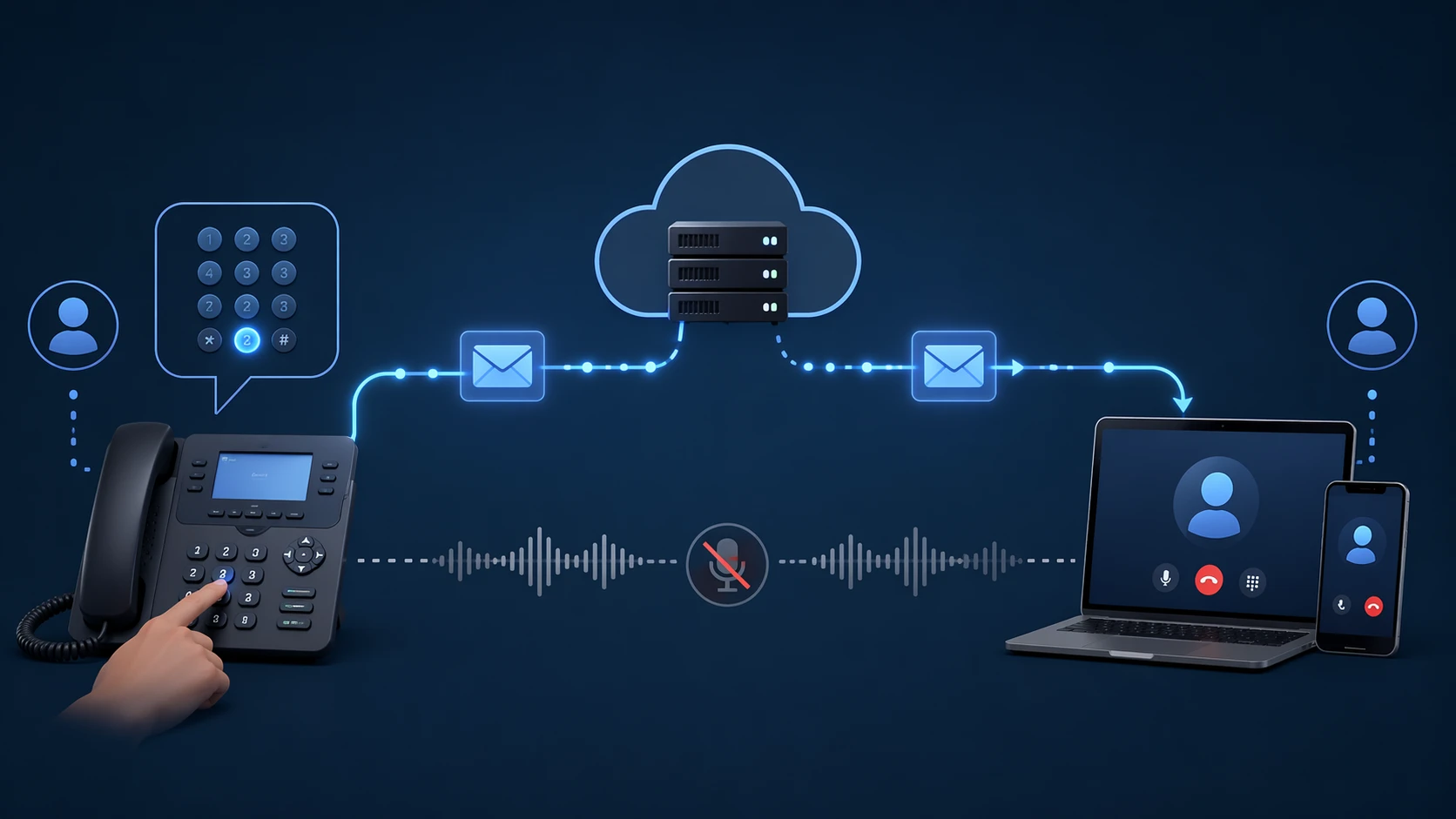
SIP INFO DTMF envía la información del teclado a través de la señalización SIP durante una sesión activa en lugar de depender únicamente de la ruta de audio de medios.
¿Qué es SIP INFO DTMF?
Definición básica
SIP INFO DTMF es un método para transmitir dígitos DTMF durante una sesión SIP establecida enviándolos en mensajes SIP INFO a lo largo de la ruta de señalización de la llamada. En lugar de pedirle al lado receptor que detecte la forma de onda de audio del tono dentro del flujo de medios RTP, el remitente transmite el dígito como información de señalización a nivel SIP. Esto hace que SIP INFO sea un enfoque de plano de señalización para la entrega de DTMF, en lugar de un método de eventos telefónicos de plano de medios.
En otras palabras, la tecla presionada se comunica como información relacionada con la sesión transportada en la señalización SIP después de que la llamada ya se haya establecido. El objetivo no es hacer que el tono suene mejor para el oyente humano. El objetivo es garantizar que el sistema remoto sepa qué dígito se presionó y pueda actuar en consecuencia correctamente.
Por qué se llama SIP INFO
El nombre proviene del método SIP INFO, definido originalmente en RFC 2976 y luego reemplazado por RFC 6086. El método INFO se creó para transportar información de señalización a mitad de la sesión a lo largo de la ruta de señalización SIP. Esa capacidad general hizo posible que las implementaciones usaran mensajes INFO para datos relacionados con DTMF durante llamadas activas. En el lenguaje cotidiano de las telecomunicaciones, este uso a menudo se denomina simplemente "SIP INFO DTMF".
Esta es la razón por la que muchos menús de centralitas PBX, teléfonos IP, ATA, SBC y puertas de enlace incluyen opciones de modo DTMF como En banda, RFC2833, SIP INFO o Automático. Cada opción representa una forma diferente de transportar la misma intención del teclado.
SIP INFO DTMF no envía el dígito del teclado como una carga útil de evento telefónico RTP. Envía información del dígito a través de la señalización SIP durante la llamada.
Cómo funciona SIP INFO DTMF
Generación de dígitos en el endpoint
Cuando un usuario presiona una tecla en un endpoint compatible, el dispositivo primero identifica el dígito DTMF deseado. En un flujo de trabajo SIP INFO, el endpoint no necesita depender únicamente de que el extremo remoto escuche y decodifique el tono de audio real. En cambio, puede construir una solicitud SIP INFO que contenga información que represente la tecla presionada y enviar esa solicitud a través de la ruta de señalización de la sesión SIP existente.
Esto puede ocurrir en muchos tipos de dispositivos, incluidos teléfonos de escritorio IP, softphones, puertas de enlace de medios, controladores de frontera de sesión, adaptadores de teléfono analógico y otros endpoints de comunicación compatibles con SIP. Dependiendo del diseño del sistema, el dispositivo puede generar tanto un tono local para el usuario como un mensaje de señalización para la red, pero el transporte principal del dígito en sí se maneja a través de la señalización SIP.
Envío del mensaje INFO durante la llamada activa
Una vez que se establece la llamada, el diálogo SIP ya existe entre las entidades SIP participantes. Cuando se presiona un dígito, el lado emisor crea una solicitud INFO y la envía a lo largo de la ruta de señalización SIP asociada con esa llamada. El lado receptor reconoce la solicitud INFO utilizando el comportamiento de respuesta SIP normal y luego interpreta el contenido relacionado con DTMF transportado dentro de ese mensaje.
Esta es la razón por la que SIP INFO se considera un método de señalización de mitad de sesión. No es un mensaje de establecimiento de llamada como INVITE ni un evento de medios RTP puro como el manejo de eventos telefónicos RFC 4733. Ocupa un papel de señalización mientras la conversación ya está en curso.
Interpretación del contenido DTMF
Después de que el mensaje SIP INFO llega al extremo remoto, el endpoint receptor, servidor, aplicación, puerta de enlace o centralita PBX procesa el contenido y determina qué dígito se envió. Ese dígito se puede pasar luego a un IVR, plataforma de correo de voz, puente de conferencia, servidor de aplicaciones, script de enrutamiento de llamadas u otra lógica que dependa de la entrada del teclado.
En términos prácticos de implementación, esto significa que el éxito de SIP INFO DTMF depende de que ambos lados de la llamada admitan el formato de mensaje elegido y acuerden cómo interpretarlo. Una llamada puede ser perfectamente saludable a nivel de audio, pero aún así no pasar DTMF utilizable si el manejo de SIP INFO es inconsistente entre dispositivos o troncales.
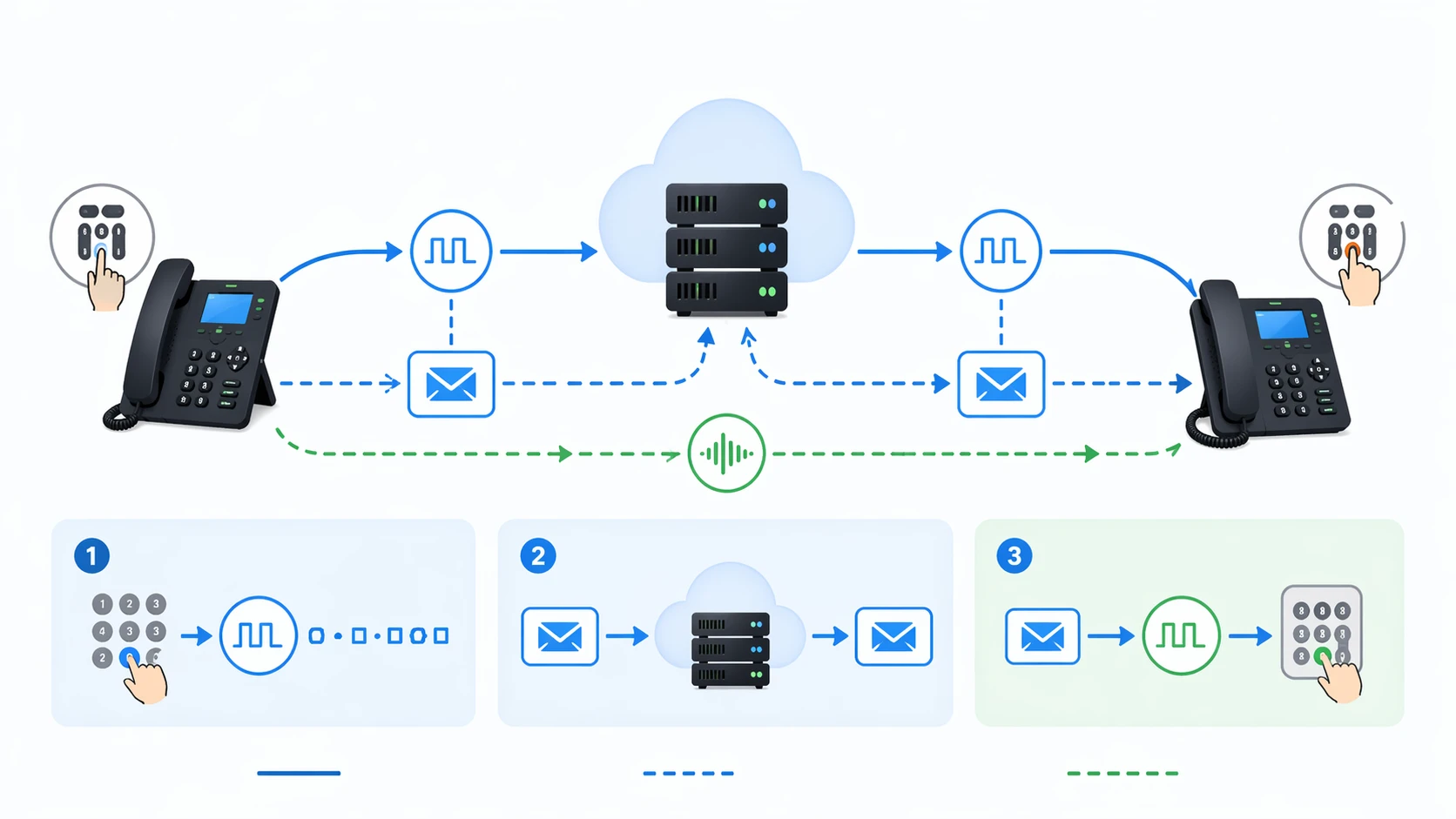
En un flujo de trabajo SIP INFO DTMF, la información del dígito se transporta a través de mensajes de señalización SIP asociados con la sesión activa.
Beneficios de audio de SIP INFO DTMF
Reducción de la dependencia de la preservación del tono de audio
Una de las mayores ventajas prácticas de SIP INFO DTMF es que no depende de que el códec de audio preserve la forma exacta de los tonos DTMF. Esto es importante en entornos VoIP porque los códecs comprimidos, la transcodificación, el ocultamiento de pérdida de paquetes, el procesamiento de eco u otros tratamientos de medios pueden distorsionar los tonos en banda. Si el equipo remoto debe reconstruir el dígito solo analizando el sonido, esos efectos de medios pueden causar fallas.
Con SIP INFO, el dígito no depende de que el extremo remoto "escuche" un tono perfecto dentro del audio. En cambio, la tecla presionada se transmite explícitamente a través de la señalización. Eso puede hacer que la interpretación por máquina sea más predecible en ciertos diseños.
Independencia del códec en muchos escenarios
Debido a que la información del dígito se envía en la señalización SIP en lugar de codificarse dentro del flujo de audio, SIP INFO puede ser atractivo en situaciones donde el códec de medios está muy comprimido o donde ocurren múltiples cambios de códec durante la llamada. No se espera que el dígito sobreviva a la compresión de voz de la misma manera que lo necesitaría en un método en banda.
Esta es una razón por la que algunos integradores prefieren SIP INFO en entornos empresariales controlados, especialmente donde se sabe que los endpoints y las centralitas PBX lo admiten de manera confiable y donde la compresión de audio sería una preocupación para el reconocimiento de DTMF en banda.
Separación clara entre el habla del usuario y la señalización de la máquina
Otro beneficio es la claridad conceptual. La voz del usuario permanece en el flujo de medios RTP, mientras que los comandos del teclado se manejan a través de la señalización. Esta separación puede hacer que el comportamiento de la aplicación sea más fácil de manejar en algunos diseños de plataforma, especialmente cuando el DTMF está destinado principalmente a sistemas de automatización en lugar de para escucha humana.
Por ejemplo, un sistema IVR o de correo de voz no se preocupa si el tono sonó natural para el llamante. Le importa que el dígito 5 se haya recibido como dígito 5. SIP INFO respalda ese objetivo al pasar el dígito como señalización relevante para la aplicación en lugar de como un sonido que debe ser reinterpretado más tarde.
El beneficio de audio de SIP INFO DTMF no es una mejor calidad de sonido de voz. Es una dependencia reducida de la ruta de voz para preservar los tonos DTMF con suficiente precisión para el reconocimiento por máquina.
Características técnicas de SIP INFO DTMF
Transporte de dígitos en el plano de señalización
La característica técnica definitoria de SIP INFO DTMF es que opera en el plano de señalización en lugar del plano de medios RTP. El dígito se transporta en una solicitud SIP INFO dentro del contexto de señalización de la sesión existente. Esto hace que el método sea fundamentalmente diferente del transporte de eventos telefónicos RFC 4733, que utiliza cargas útiles RTP asociadas con la sesión de medios.
Esta naturaleza de plano de señalización afecta la forma en que se comporta el método con proxies, SBC, B2BUA, PBX y aplicaciones que inspeccionan o transforman diálogos SIP. También afecta la forma en que se realiza la solución de problemas, porque los ingenieros pueden necesitar inspeccionar trazas SIP en lugar de solo capturas de paquetes RTP.
Comportamiento de transporte a mitad de sesión
SIP INFO está diseñado para la transferencia de información a mitad de sesión, lo que significa que la llamada ya está establecida cuando se envía la información DTMF. La ruta de señalización del diálogo SIP permanece activa y se pueden intercambiar solicitudes INFO durante la sesión según sea necesario. Es por eso que SIP INFO puede ser conveniente en arquitecturas donde se espera o se gestiona centralmente la señalización de la aplicación durante una llamada.
Sin embargo, el hecho de que dependa de la ruta de señalización SIP también significa que está influenciado por el comportamiento de enrutamiento SIP, el estado del diálogo, el soporte de intermediarios y los controles de política de una manera que los eventos telefónicos RTP no lo están.
La interoperabilidad depende de los detalles de implementación
Una realidad técnica práctica es que SIP INFO DTMF no siempre se implementa exactamente de la misma manera en todos los productos y proveedores. Diferentes sistemas pueden usar diferentes tipos de contenido, convenciones de formato o expectativas sobre cómo se interpreta el cuerpo del INFO. Como resultado, dos productos pueden afirmar ser compatibles con SIP INFO pero aún así requerir pruebas o ajustes de perfil para una interoperabilidad confiable.
Esta es una razón por la que SIP INFO puede funcionar muy bien dentro de un ecosistema empresarial o de proveedor conocido, pero ser menos predecible en troncales heterogéneos y entornos de operadores multivendedor.
Útil en escenarios de control de puertas de enlace y centralitas PBX
SIP INFO a menudo es relevante donde las puertas de enlace, centralitas PBX, servidores de aplicaciones o SBC necesitan conciencia a nivel de señalización de los dígitos. En estos entornos, el DTMF no se trata solo como otro evento de medios. Se convierte en una entrada de control de sesión que puede ser analizada, registrada, transformada o utilizada para activar la lógica de la aplicación en una arquitectura orientada a la señalización.
Eso puede ser especialmente útil en telefonía empresarial, interfuncionamiento con sistemas heredados y ciertos diseños de servicios controlados donde el comportamiento de la plataforma se gestiona más estrictamente que en la interconexión de troncales públicas abiertas.
SIP INFO DTMF vs RFC 4733 vs DTMF en banda
Los sistemas VoIP comúnmente usan tres métodos amplios para el transporte de DTMF: DTMF en banda, SIP INFO y eventos telefónicos RTP, a menudo denominados en el lenguaje cotidiano como RFC2833, aunque RFC 4733 es la referencia de estándares actual que dejó obsoleta la RFC 2833. Cada método tiene un modelo operativo diferente, y comprender la diferencia es esencial para la implementación y la solución de problemas.
| Método | Ruta de transporte | Principal fortaleza | Principal limitación |
|---|---|---|---|
| En banda | Tonos audibles dentro del flujo de audio de voz | Simple en algunas rutas de audio puras | Vulnerable a la compresión del códec y al procesamiento de medios |
| SIP INFO | Mensajes de señalización SIP durante la llamada activa | No depende de la preservación del tono en el flujo de audio | Puede tener límites de interoperabilidad a través de algunos troncales o plataformas |
| Evento telefónico RFC 4733 | Paquetes de eventos de plano de medios RTP | Ampliamente utilizado y compatible en sistemas VoIP |
En muchos entornos empresariales y de proveedores, el transporte de eventos telefónicos RFC 4733 es la opción más comúnmente preferida porque combina un amplio soporte con el manejo de eventos asociados a medios. SIP INFO sigue siendo útil, pero a menudo se elige para casos particulares de interoperabilidad, políticas de PBX, arquitecturas de aplicación o ecosistemas de proveedores, en lugar de ser el predeterminado universal en todas partes.
SIP INFO y RFC 4733 resuelven un problema de negocio similar, pero no lo hacen de la misma manera. Uno está basado en señalización y el otro está basado en eventos de medios.
Dónde se usa comúnmente SIP INFO DTMF
Entornos de centralitas PBX empresariales
Las centralitas PBX SIP empresariales y los sistemas de comunicaciones unificadas a menudo admiten SIP INFO DTMF como una opción configurable. En estos entornos, los administradores pueden elegir el modo DTMF que mejor se adapte a los teléfonos, puertas de enlace, troncales y servidores de aplicaciones ya en uso. SIP INFO puede funcionar bien cuando los endpoints y la plataforma de control de llamadas están diseñados para manejarlo de manera consistente.
Esto es especialmente cierto en implementaciones cerradas o semicontroladas donde la misma familia de proveedores o perfiles de interfuncionamiento certificados definen cómo se deben transportar los dígitos en todo el entorno.
Integración de correo de voz y IVR
Algunos sistemas de correo de voz, plataformas IVR y servidores de aplicaciones pueden funcionar con SIP INFO DTMF cuando su lógica de señalización está alineada con la centralita PBX o puerta de enlace que recibe la llamada. En esos casos, el dígito se entrega a la plataforma de automatización a través de un flujo consciente de señalización en lugar de solo a través del análisis de audio reconstruido.
Esto puede ser útil en sistemas de negocio estrechamente integrados donde la capa de señalización ya es central para el control de funciones y el comportamiento de la aplicación.
Puertas de enlace y proyectos de interfuncionamiento con sistemas heredados
Las puertas de enlace de medios y las ATA a veces usan SIP INFO DTMF cuando sirven como puente entre entornos de telefonía heredados y sistemas basados en SIP. Por ejemplo, una puerta de enlace puede detectar DTMF desde el lado analógico o TDM y retransmitirlo a la red SIP usando mensajes INFO cuando el extremo remoto espera ese comportamiento. Esto puede ayudar a preservar los flujos de trabajo de servicios heredados mientras se adaptan al control de llamadas IP.
Sin embargo, tales implementaciones necesitan una configuración cuidadosa, porque las reglas de interfuncionamiento de la puerta de enlace también pueden mapear entre en banda, SIP INFO y RFC 4733 dependiendo del requisito del destino.
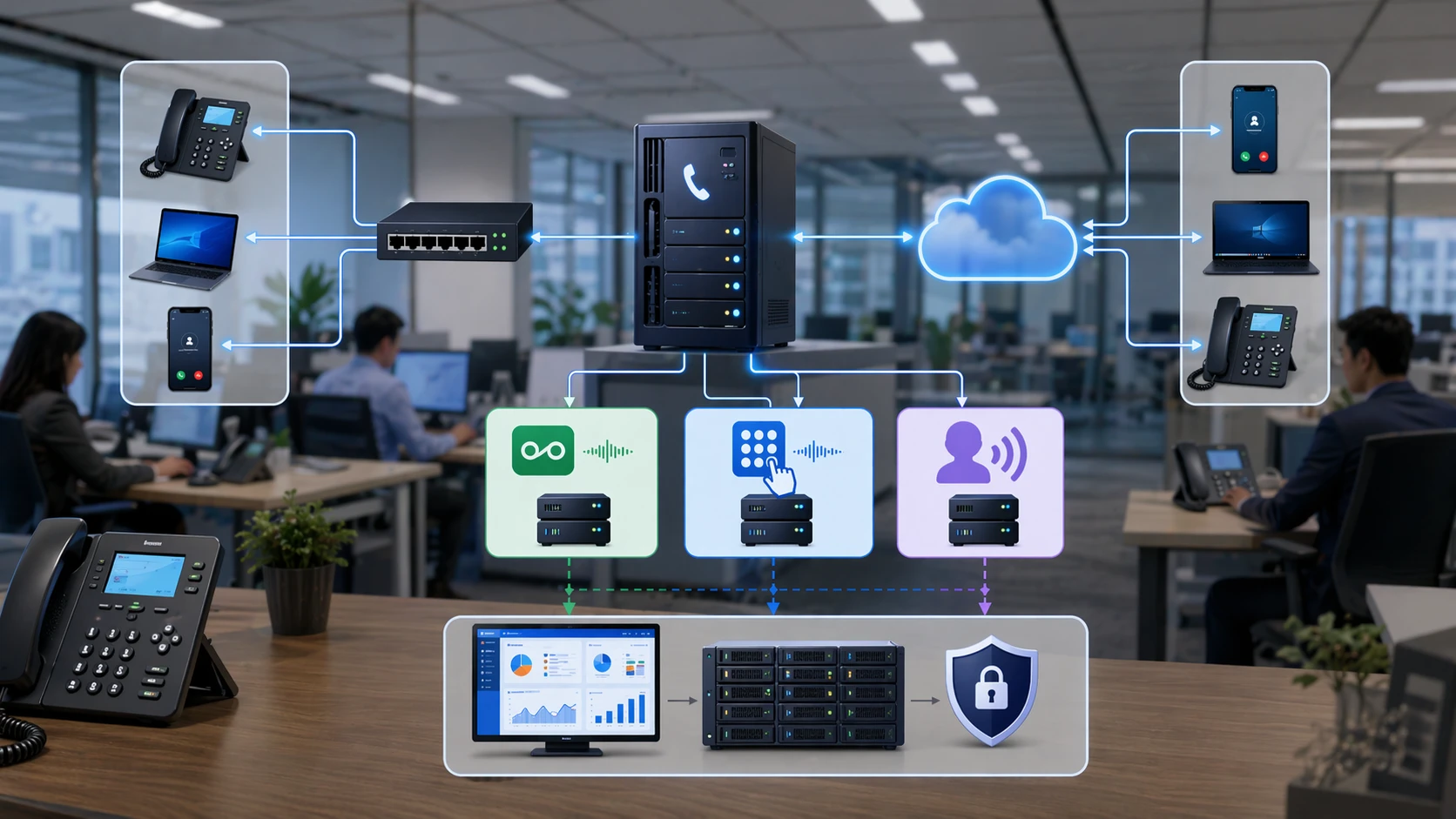
SIP INFO DTMF se usa a menudo en entornos de PBX, IVR, correo de voz, puertas de enlace y VoIP empresarial controlados.
Plataformas de aplicaciones SIP controladas
Algunos entornos de aplicaciones SIP prefieren SIP INFO porque el DTMF se vuelve visible dentro de la ruta de señalización utilizada por la pila de aplicaciones. Esto puede ser útil cuando el comportamiento de la aplicación, la activación de flujos de trabajo o el control de transacciones está estrechamente vinculado a la lógica de señalización SIP en lugar de solo a la lógica de manejo de medios.
En tales plataformas, SIP INFO puede encajar naturalmente en la filosofía de diseño de la aplicación incluso si no es el método más ampliamente preferido para todos los escenarios de troncales externas.
Principales ventajas de SIP INFO DTMF
Independiente de la precisión del códec de voz
Una ventaja importante es que el extremo remoto no necesita decodificar la forma de onda del tono DTMF a partir del audio de voz comprimido. Esto reduce el riesgo de corrupción de dígitos causada por códecs de baja tasa de bits, transcodificación, supresión de silencio u otros tratamientos de la ruta de voz que pueden dañar el DTMF en banda.
Para los sistemas que han tenido problemas con el reconocimiento en banda, ese beneficio puede ser inmediatamente significativo.
Visibilidad clara de la señalización de la sesión
Otra ventaja es que el dígito se vuelve visible en el intercambio de señalización SIP. Esto puede ayudar con la lógica de la aplicación, la integración de la plataforma, el control de políticas, el registro o la solución de problemas en entornos donde las trazas SIP ya son centrales para las operaciones y los flujos de trabajo de soporte.
En esos casos, SIP INFO puede proporcionar transparencia operativa que es más difícil de obtener cuando el DTMF existe solo como un tono en el flujo RTP.
Útil en integración multivendor controlada
Cuando los integradores conocen el comportamiento de la centralita PBX, el endpoint, la puerta de enlace y el servidor de aplicaciones, SIP INFO puede ser una opción práctica que funcione de manera consistente. También puede ser útil cuando un troncal o aplicación específica prefiere explícitamente el transporte de dígitos basado en señalización o cuando una puerta de enlace necesita interfuncionar entre diferentes mundos de DTMF.
Esto hace que SIP INFO sea valioso como parte del conjunto de herramientas del ingeniero, incluso cuando no es siempre la primera recomendación para cada caso de interconexión abierta.
Limitaciones y desafíos comunes
No siempre es preferido por los proveedores de servicios
Una de las limitaciones prácticas más importantes es que algunos troncales SIP, operadores o servicios de voz alojados no prefieren SIP INFO como el método DTMF principal para la interconexión de extremo a extremo. Muchos proveedores se inclinan más hacia el manejo de eventos telefónicos RFC 4733 porque está ampliamente establecido para el transporte de DTMF asociado con sesiones de medios RTP.
Esto significa que SIP INFO puede funcionar muy bien dentro de un dominio empresarial, pero volverse menos ideal una vez que la llamada cruza los límites del proveedor o intermediarios multivendedor.
El manejo por intermediarios puede afectar los resultados
Debido a que SIP INFO viaja a través de la ruta de señalización, los B2BUA, SBC, proxies, servidores de aplicaciones y centralitas PBX pueden influir en cómo se enruta, normaliza, transforma o termina el mensaje. Si un intermediario no pasa la solicitud INFO correctamente, no entiende el contenido esperado o aplica una política restrictiva, el DTMF puede fallar incluso mientras la llamada de voz continúa normalmente.
Este es un modo de falla diferente de los problemas clásicos de DTMF en banda, pero puede ser igualmente disruptivo en implementaciones prácticas.
Diferencias en el formato de implementación
Otro desafío es la variación en la implementación. Diferentes productos pueden admitir SIP INFO DTMF con detalles de formato o expectativas ligeramente diferentes. Esta es la razón por la que las pruebas de laboratorio y la validación de interoperabilidad siguen siendo importantes al integrar diferentes proveedores, especialmente en aplicaciones que dependen en gran medida de una entrada DTMF precisa.
En otras palabras, el soporte para SIP INFO en una hoja de datos no siempre garantiza una interoperabilidad sin fricciones en el campo.
Puede aumentar la dependencia de la señalización
Debido a que el método depende de la señalización SIP durante la sesión, vincula la entrega exitosa de DTMF a la salud y el comportamiento de la ruta de señalización. En muchos sistemas, esto es completamente aceptable, pero en otros puede verse como menos elegante que un método de evento asociado a medios que permanece más cerca de la sesión RTP. Esta es una razón por la que algunos ingenieros todavía prefieren los eventos telefónicos RTP cuando son compatibles de extremo a extremo.
La mejor opción depende de la arquitectura exacta, no de una regla única para todos.
Si la voz funciona pero los dígitos fallan, es posible que el problema no sea en absoluto la calidad del audio. En implementaciones SIP INFO, el problema real suele ser la compatibilidad de señalización, el comportamiento del intermediario o las expectativas de DTMF no coincidentes entre los tramos de la llamada.
Cuándo elegir SIP INFO DTMF
Cuando la aplicación lo espera explícitamente
SIP INFO es un candidato sólido cuando la centralita PBX, el servidor de aplicaciones, la plataforma de correo de voz o el ecosistema de puertas de enlace espera explícitamente DTMF basado en señalización y tiene soporte conocido para ese enfoque. En tales casos, elegir SIP INFO puede simplificar el interfuncionamiento y reducir la dependencia de la preservación del tono de audio.
Esto es especialmente cierto en entornos empresariales donde el proveedor de la plataforma o la guía de interfuncionamiento certificada recomienda SIP INFO para ciertas funciones o integraciones.
Cuando el DTMF en banda no es confiable
Si los códecs de voz comprimidos o el procesamiento de medios han creado problemas repetidos con el DTMF en banda, SIP INFO puede proporcionar una alternativa más limpia. Permite que el dígito viaje como información de señalización en lugar de como un sonido que debe sobrevivir intacto al tratamiento del códec.
Sin embargo, esto aún debe equilibrarse con el soporte del troncal y la compatibilidad de extremo a extremo. Reemplazar un modo de falla con otro no es útil si el extremo remoto no quiere SIP INFO.
Cuando la solución de problemas o la visibilidad de la señalización es importante
En algunas implementaciones, la capacidad de inspeccionar DTMF a nivel de señalización SIP es valiosa en sí misma. Los equipos de soporte pueden preferir la visibilidad que proporciona SIP INFO en el análisis de trazas SIP, especialmente al diagnosticar problemas de automatización en centralitas PBX o aplicaciones de llamadas.
Esa visibilidad operativa puede hacer que el aislamiento de problemas sea más fácil en el entorno adecuado.
Conclusión
SIP INFO DTMF es un método basado en señalización para transportar dígitos del teclado durante una llamada SIP activa. En lugar de depender de tonos audibles dentro del flujo de voz RTP, entrega información DTMF a través de mensajes SIP INFO a lo largo de la ruta de señalización de la sesión. Esto le da una clara ventaja práctica en situaciones donde la compresión de audio, la transcodificación o el procesamiento de medios pueden interferir con el reconocimiento de tonos en banda.
Sus fortalezas son más visibles en entornos VoIP controlados, como centralitas PBX empresariales, puertas de enlace, plataformas de correo de voz, integraciones IVR y aplicaciones conscientes de señalización. Al mismo tiempo, no es automáticamente la mejor respuesta para cada entorno de troncal o proveedor. Su éxito depende en gran medida de la interoperabilidad del lado SIP, el comportamiento del endpoint, el manejo de intermediarios y las expectativas de la plataforma remota.
En resumen, SIP INFO DTMF es una herramienta VoIP importante para el transporte de dígitos en el plano de señalización. Es especialmente útil cuando los ingenieros quieren que el DTMF se transporte como información de sesión explícita en lugar de como un tono oculto dentro de la ruta de medios. Cuando se elige cuidadosamente, puede mejorar la confiabilidad, la visibilidad y el control de la aplicación en la arquitectura de comunicaciones adecuada.
Preguntas frecuentes (FAQ)
¿Qué es SIP INFO DTMF?
SIP INFO DTMF es un método para enviar dígitos del teclado durante una llamada SIP a través de mensajes de señalización SIP INFO en lugar de depender solo de tonos dentro del flujo de audio.
¿Es SIP INFO lo mismo que RFC2833 o RFC4733?
No. SIP INFO envía información de dígitos en la señalización SIP, mientras que el transporte de eventos telefónicos RFC 4733 envía DTMF como eventos de medios RTP. Resuelven problemas similares con diferentes métodos de transporte.
¿Cuál es el principal beneficio de SIP INFO DTMF?
El principal beneficio es que reduce la dependencia de que la ruta de audio preserve los tonos DTMF con precisión, lo que puede ayudar en entornos afectados por la compresión o el procesamiento de medios.
¿SIP INFO DTMF mejora la calidad de voz?
No directamente. Su beneficio es un mejor comportamiento de transporte de dígitos para máquinas y aplicaciones, no un sonido de voz de mejor calidad para los usuarios humanos.
¿Dónde se usa comúnmente SIP INFO DTMF?
Se usa comúnmente en centralitas PBX empresariales, puertas de enlace, sistemas de correo de voz, aplicaciones IVR, plataformas VoIP controladas y algunos escenarios de interfuncionamiento con sistemas heredados.
¿Por qué puede fallar SIP INFO DTMF incluso cuando el audio de la llamada está bien?
Porque los dígitos dependen de la compatibilidad de la señalización SIP. Los problemas con SBC, PBX, troncales de proveedores, formato INFO o expectativas no coincidentes en los tramos de la llamada pueden romper el DTMF mientras dejan el audio de voz sin afectar.
¿Cuándo se debe elegir SIP INFO DTMF?
Es una buena opción cuando la aplicación o la centralita PBX lo admite explícitamente, cuando los tonos en banda no son confiables, o cuando la visibilidad y el control a nivel de señalización son importantes en la implementación.