Quality of Experience, usually called QoE, refers to how end users actually perceive the performance and usability of a service. In communication networks and digital platforms, it is not enough for a system to be technically available or statistically efficient. What matters in practice is whether the user feels that a voice call is clear, whether a video session is smooth, whether a page loads quickly enough, and whether the service is reliable under real operating conditions.
QoE is often discussed in VoIP, video conferencing, live streaming, unified communications, cloud applications, mobile services, and enterprise networks. It shifts the focus from pure technical indicators to the real human outcome of service delivery. A network may show acceptable engineering metrics, but if users still experience delay, distortion, buffering, or disruption, the actual experience is poor. That gap is exactly why QoE matters.
Quality of Experience measures service quality from the user’s point of view, not only from the network’s point of view.
Understanding the Meaning of Quality of Experience
QoE focuses on perception rather than raw network statistics
Traditional network evaluation often relies on technical measurements such as latency, jitter, packet loss, throughput, or availability. These values are important, but they do not automatically describe whether a person considers the service acceptable. QoE adds the user layer to the analysis. It asks how a human experiences the result delivered by the system.
For example, two video calls may have similar packet loss levels, yet one feels acceptable while the other feels frustrating. That difference can come from codec behavior, device performance, screen quality, audio processing, application design, or user expectations. QoE therefore combines technical performance with contextual and perceptual factors.
QoE is broader than voice and video quality alone
Many people first encounter QoE in telecommunications, especially in relation to call quality or streaming performance. However, the concept is much broader. It can apply to websites, mobile applications, industrial communication systems, telemedicine platforms, customer service portals, and remote operation tools.
In all of these environments, QoE describes the practical satisfaction level of the end user. The experience may depend on responsiveness, clarity, continuity, stability, ease of use, and consistency. In other words, QoE is not only about signal transport. It is also about whether the full service feels effective and usable.

QoE evaluates communication and digital services from the perspective of actual user perception.
How QoE Works in Real Communication Environments
QoE is influenced by multiple technical and human factors
QoE is not produced by a single measurement. It is the outcome of several layers working together. Network conditions still matter greatly, especially latency, jitter, packet loss, bandwidth stability, and congestion. At the same time, application logic, codec selection, endpoint hardware, echo control, noise suppression, screen rendering, and device processing power all contribute to the final experience.
User context also plays a role. Expectations differ between a casual consumer video stream and a mission-critical dispatch call. A brief delay in entertainment content may be tolerated, while the same delay in emergency communication could be unacceptable. QoE assessment therefore requires both objective observation and service-specific interpretation.
QoE links objective indicators with subjective outcomes
In practice, QoE is often estimated through a combination of measurable data and user-centered scoring models. Objective indicators may include call setup time, retransmissions, dropped sessions, buffering frequency, media delay, or application response time. These values are then mapped to predicted user satisfaction or service quality levels.
Some systems also use direct feedback, user surveys, or Mean Opinion Score style methods to understand perceived quality. Others rely on analytics engines that infer likely user experience from traffic behavior, media quality patterns, and endpoint reports. The goal is to translate technical telemetry into a more realistic picture of service quality.
QoE monitoring is usually continuous rather than occasional
Modern networks and communication platforms do not treat QoE as a one-time test item. Instead, they monitor it continuously across sessions, sites, users, and device types. Real-time visibility helps operators detect service degradation before complaints become widespread.
For example, if a VoIP platform suddenly shows rising packet loss, increased call setup delays, and repeated audio clipping in one branch office, the system can identify a likely QoE problem even before formal fault tickets are submitted. Continuous observation is especially valuable in enterprise, carrier, industrial, and public safety environments.
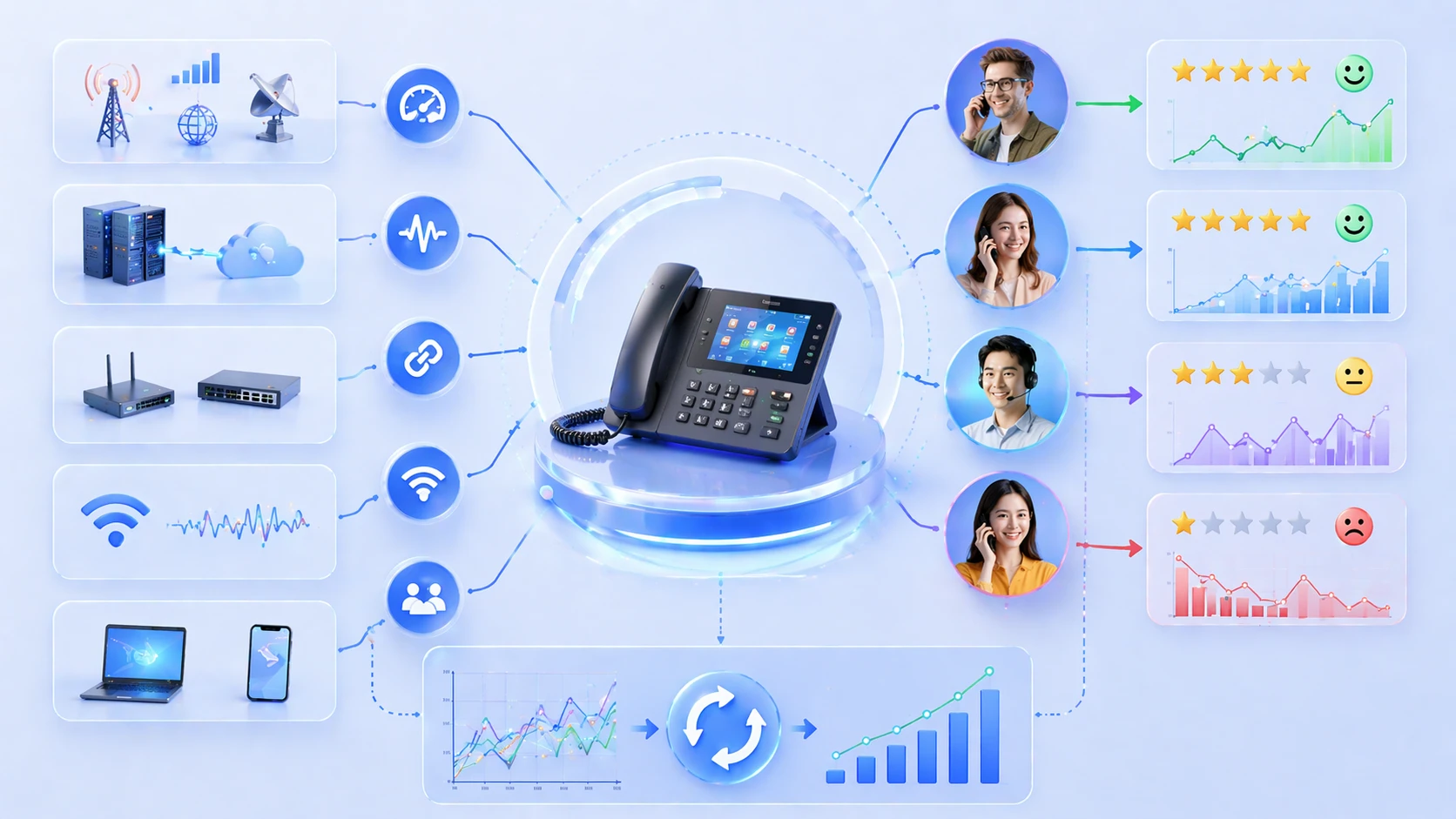
QoE monitoring combines network indicators, application behavior, and user-facing service outcomes.
QoE vs QoS: What Is the Difference?
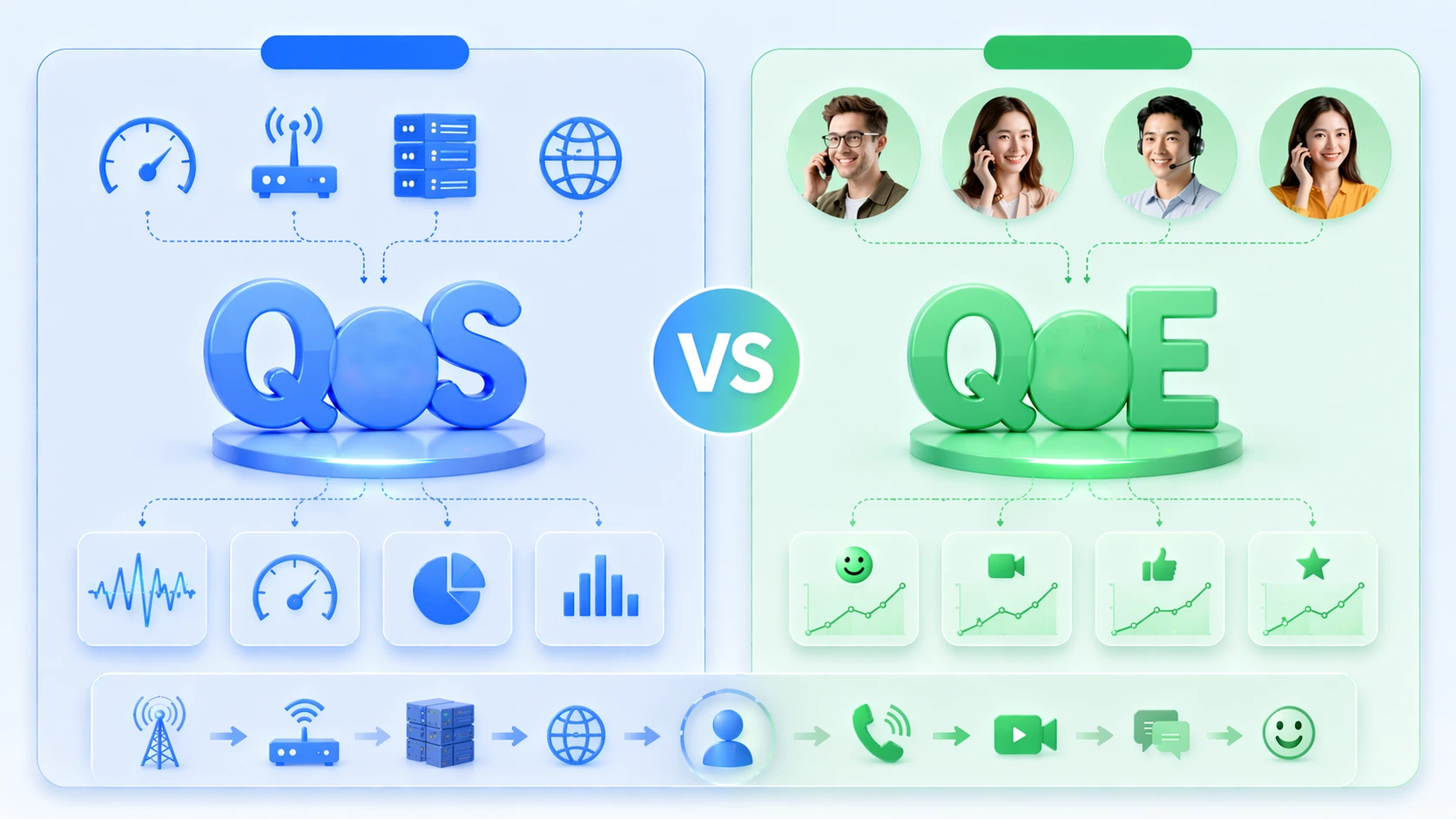
QoS measures network delivery conditions
Quality of Service, or QoS, is a network-oriented concept. It is mainly concerned with how traffic is handled inside the infrastructure. QoS policies may prioritize voice packets, reserve bandwidth, reduce congestion impact, or classify traffic to improve delivery performance for critical services.
These mechanisms are essential for supporting real-time applications. They help networks behave more predictably, especially when multiple services compete for limited resources. However, QoS by itself does not fully explain how the user feels about the service outcome.
QoE measures the final user experience
QoE sits at a different level. It looks at the result that the user actually receives. A network can have QoS rules configured correctly and still produce a disappointing experience if the application is poorly optimized, the endpoint is overloaded, or the service workflow is confusing.
That is why QoS and QoE are related but not interchangeable. QoS helps create the technical conditions for good service performance, while QoE determines whether those conditions are sufficient in real user scenarios. In many projects, QoS is part of the means, but QoE is the business outcome.
QoS helps the network behave better. QoE shows whether users actually feel the improvement.
Key Benefits of Quality of Experience
Better visibility into real service performance
One of the biggest advantages of QoE is that it reveals service quality more realistically than infrastructure metrics alone. IT teams, service providers, and system integrators can see whether the delivered service is genuinely usable at the endpoint, not merely operational in the core network.
This matters because users judge service quality based on what they hear, see, and experience. QoE makes that reality measurable. It turns vague complaints such as “the system feels slow” or “the call was bad” into structured operational insight.
Faster troubleshooting and root cause analysis
When organizations track QoE, they can identify degraded services more quickly and isolate probable causes with greater accuracy. A poor experience may be linked to bandwidth issues, wireless instability, overloaded devices, media handling problems, or application-side delays. QoE analytics help narrow the investigation.
This improves operational efficiency and reduces the time spent chasing faults across different layers. Instead of only looking at infrastructure counters, teams can correlate user complaints with session-level experience data and service behavior.
Improved user satisfaction and service adoption
Users are more likely to trust and continue using a platform when the experience is stable, clear, and responsive. This is true for business telephony, contact centers, cloud collaboration, remote learning, telehealth, industrial voice systems, and many other applications.
By optimizing for QoE, organizations protect both productivity and reputation. A technically advanced platform still fails commercially if end users find it unreliable or frustrating. Better experience often leads to stronger adoption, fewer support tickets, and more confidence in the service.
More effective investment and optimization decisions
QoE helps organizations decide where improvements will have the greatest practical impact. Instead of upgrading infrastructure blindly, they can focus on the services, locations, or workflows where users are actually experiencing difficulty.
This makes performance investment more targeted. It also helps justify optimization projects with user-centered evidence rather than purely abstract technical arguments.
Where QoE Is Commonly Applied
VoIP and IP telephony
QoE is widely used in VoIP systems because voice communication is highly sensitive to delay, jitter, packet loss, echo, and codec behavior. Users immediately notice clipped audio, robotic speech, one-way audio, or long post-dial delays. Measuring QoE helps teams maintain acceptable business calling performance.
In enterprise IP PBX deployments, SIP trunk environments, and industrial communication platforms, QoE can be used to evaluate call clarity, setup reliability, and overall session stability across sites and network conditions.
Video conferencing and unified communications
Modern collaboration depends heavily on video meetings, screen sharing, messaging, and integrated calling. In these environments, poor QoE can affect meeting efficiency, decision making, customer interaction, and remote teamwork. Frozen screens, audio-video desynchronization, and unstable media sessions quickly reduce confidence in the platform.
QoE monitoring supports more consistent collaboration by helping operators detect performance issues across branches, home users, wireless links, and cloud-based communication services.
Streaming media and content delivery
Streaming services rely on QoE to understand whether viewers experience smooth playback, acceptable startup time, and sufficient visual quality. Even when content is technically delivered, repeated buffering or sharp quality fluctuations can make the service feel poor.
For this reason, content providers often track startup delay, rebuffering events, bitrate adaptation behavior, and playback continuity as part of their QoE model.
Mobile and wireless services
Mobile environments introduce changing signal strength, handovers, variable congestion, and device diversity. QoE provides a practical way to judge whether subscribers can really use voice, video, messaging, and app services successfully across different locations and conditions.
This is especially valuable for operators seeking to compare regional performance, improve customer retention, or optimize service quality in dense urban and challenging edge-coverage areas.
Industrial and mission-critical communications
In industrial plants, transport networks, emergency communication systems, and control room environments, experience quality is directly linked to operational reliability. A delayed page, distorted emergency call, or unstable dispatch session is not just inconvenient. It can affect response speed, coordination, and safety.
QoE therefore has strong value in systems that combine SIP calling, intercom, paging, alarms, video integration, and remote communications. It helps ensure that the service works effectively for real operators under real field conditions.
In mission-critical environments, QoE is not only about convenience. It can also influence safety, coordination, and operational continuity.
Factors That Can Reduce QoE
Network instability and congestion
Unstable routing, insufficient bandwidth, congestion, excessive latency, and burst packet loss are common causes of degraded experience. Real-time applications are particularly vulnerable because they depend on consistent packet delivery and low delay variation.
Even if connectivity is not fully lost, fluctuating network quality can still make the service feel unreliable to end users.
Weak endpoint or application performance
Poor QoE is not always caused by the transport network. Underpowered devices, bad microphones, low-quality speakers, CPU overload, software bugs, poor codec handling, or inefficient client applications can also reduce perceived quality.
This is why troubleshooting should include endpoints and application behavior, not just links and switches.
Improper service design or user workflow
User experience can degrade when the service design itself is confusing or inconsistent. Long call setup flows, delayed user interface feedback, unstable authentication, or unnecessary interaction steps may create frustration even when underlying connectivity is acceptable.
QoE must therefore be considered as part of service design, not only network engineering.
Best Practices for Improving QoE
Align infrastructure with service priorities
Organizations should identify which services are most sensitive to user experience and then align network, application, and endpoint resources accordingly. Voice, video, dispatch, and other real-time services usually need low-delay handling, stable access, and suitable media optimization.
Priority policies, resilient links, proper codec selection, and endpoint tuning all help support better experience, especially in multi-site or high-load environments.
Use end-to-end monitoring instead of isolated metrics
Good QoE management requires visibility from the user device to the application platform and the transport path in between. Looking at one layer in isolation often produces incomplete conclusions. End-to-end monitoring creates a more accurate picture of what users are actually facing.
This also helps distinguish whether a problem is local, regional, application-specific, or network-wide.
Measure continuously and respond proactively
QoE should be tracked over time, not only after incidents. Trend analysis makes it easier to detect recurring weak points, compare sites, evaluate upgrades, and intervene before users are heavily affected.
In business and industrial environments, proactive QoE management supports both service continuity and long-term user confidence.
Conclusion
Quality of Experience is the practical measure of how users perceive the performance, clarity, responsiveness, and reliability of a service. Unlike purely technical metrics, QoE reflects the real result delivered to the end user across voice, video, applications, and digital communication workflows.
It works by connecting objective performance indicators with user-centered outcomes. This makes it valuable for troubleshooting, optimization, service assurance, and long-term platform improvement. Whether the environment involves VoIP, unified communications, streaming, mobile services, or mission-critical industrial communications, QoE helps organizations focus on what ultimately matters most: the actual user experience.
FAQ
What does QoE stand for?
QoE stands for Quality of Experience. It describes how users perceive the quality and usability of a service in real operation.
Is QoE the same as QoS?
No. QoS focuses on network delivery behavior such as latency, jitter, and prioritization, while QoE focuses on the final experience perceived by the end user.
Why is QoE important for VoIP?
VoIP users are highly sensitive to delay, audio distortion, jitter, echo, and dropped sessions. QoE helps determine whether call quality is actually acceptable in real communication scenarios.
Can QoE be measured objectively?
Yes. While QoE is user-centered, it can be estimated through objective data such as packet loss, delay, buffering, call setup time, session stability, endpoint reports, and quality scoring models.
Where is QoE commonly used?
QoE is commonly applied in VoIP, video conferencing, streaming media, mobile networks, cloud applications, customer service platforms, and industrial or mission-critical communication systems.